I’m a Sucker for a Good Speaker
Aug 21, 2025

I’m a sucker for a good speaker.
Maybe it’s because I meld into the audience, maybe it’s their speech patterns, or the way they boil things down to truisms and idioms that make even the most complex issues seem simple. Whatever the reason, when I leave a conference I almost always feel energized by some new idea or lens to view the world through. “It really is that easy,” I think to myself as I get back to work.
As it turns out, it is not “really that easy.”
Many times the advice doesn’t work, at least not at face value. I’d chalk it up to me having done something wrong. I misinterpreted their advice, or missed a step, or didn’t apply it correctly. For decades, and, well, even now more than I like to admit to myself, I usually think it is my fault.
Maybe you’ve found yourself in the same boat. Wondering “what the hell is wrong with me, the speaker made it seem so easy?”
A Dividing Line
Over time, I noticed how stark the contrast was between the advice offered by speakers vs advice shared by peers or mentors further along in their journeys than I was. At one point in my 20’s I was lucky enough to get to meet a few dozen very successful entrepreneurs as a part of a group called CADRE. I spent the better part of a year meeting people who were remarkably successful - leaders of firms with hundreds of employees, consultants in high demand around the globe, people who were in the DC area because they were the go-to person in their specialty. As you might imagine, they were some of the most capable, intelligent, and intentional people I’d ever met. Upon first meeting, because of their stature and position, they were also all quite intimidating. Such intimidation made it that much more surprising when I discovered that each of them were kind, remarkably humble, and incredibly thoughtful.
The advice they shared with me stood in stark contrast to most of the speakers I’d seen. The speakers made things sound straightforward. Simple. Easy.
The leaders who were in the mix day to day, doing the work? They did not make things sound easy. They admitted it was hard. Complex. Messy.
Their advice was multifaceted, nuanced, and almost universally ended with the same kind of disclaimer. “That’s what worked for me, but you’ll have to figure out what works for you.”
I didn’t realize it at the time, but a dividing line was forming in my mind between the types of people who give you advice. It now reminds me of Mary Schmich’s quote (though I recall it from the Baz Luhrmann song).
Be careful whose advice you buy.
Over time, I also learned many of the clients and partners we worked with had also seen, heard, and hired these same speakers. They would confide to me in private their frustrations in working with so-and-so, but would praise them in public, both online and in person.
It’s Hard to See in the Dark
I struggled with this disconnect for years - how did these people heralded as so wildly successful speak so simply and confidently about their approaches - while even in the rooms they were speaking in, some of their own clients and customers whispered warnings about working with them?
Sure, there are some scumbags and snake oil salesmen out there; for the most part, I think speakers are well-meaning and have positive intentions. I don’t think they want or intend to mislead anyone.
They truly believe in their methods and recommendations, and there are a handful of factors that prevent them from seeing information that could change their mind.
The Law of Truly Large Numbers
“The Halo Effect”
Survivorship Bias
Asymmetric Feedback
Motivated Reasoning
The Law of Truly Large Numbers
Very different than the “Law of Large Numbers” - The Law of Truly Large Numbers states that in statistics, any highly unlikely result is still likely to occur, given a large enough number of independent samples.
There is a classic stockbroker scam that is related to this law, you may be familiar with it:
The stockbroker gets a large list of contacts, let’s say one million.
They email them all, saying their stock picks are consistently bulletproof.
They then divide the list in half; one half they tell Apple will go up next week, the other half? Apple will go down.
500,000 call the stockbroker an idiot and unsubscribe.
However, the other 500,000 think he’s on to something…
The stockbroker does it again, 250,000. And again, 125,000. And so on, 62,500.
For a month straight, to the remaining 62,500 people, this broker has picked nothing but winners.
The broker finally makes the pitch - sign up for my newsletter, class, or whatever for just $100.
And just like that, if even a fifth of the remaining list buys, our stockbroker just made out with over a cool million dollars in 5 easy emails.
Speakers, again, for the most part, aren’t acting so disingenuously. But, the same effect still applies. Some percentage of the audience will apply the advice, and it will correlate with some positive change in their organization. A speaker, even one giving routinely terrible advice, will, given a large enough audience, have some audience members attribute their success to the speaker’s suggestions.
Which leads to the next effect, as this subgroup of people who believe to have benefited from the advice, also fall prey to “The Halo Effect.”
“The Halo Effect”
In the 1920’s, a psychologist named Edward Thorndike noticed military officers ratings of soldiers on different characteristics - intelligence, physique, leadership, character, etc. - correlated far more highly than a truly independent assessment should. He drew the conclusion that strong performance in one area casts a “halo” over all the others. (He also noticed the “horn effect” working the same way, but applied negatively.)
In 2007, Phil Rosenzweig published “The Halo Effect” showing how this same fallacy shows up in the world of business. A “successful” business is identified as such, and then deemed to have a successful culture, leadership, values, etc.
A business is notoriously complex, and it is incredibly difficult to attribute success, or failure, to any one variable. However, as we just saw, with a large enough audience, some number of them will have heard the speaker’s advice, implemented it in some capacity, and find success followed. The beneficiary casts a halo on the speaker, and is more likely to both assume whatever else they say and do is correct, and are more likely to share the news of the impact the speaker had on them with their peers.
Survivorship Bias
The Halo Effect then combines with Survivorship Bias, which, explained quickly, a bias in which when we count a sample, we only count what is available to count. Made famous by the now meme-ified Survivorship Bias Plane - where the US Air Force could only sample damage to aircraft that actually returned, not the ones that were shot down.

(For those who aren’t aware, the above is a hypothetical representation of where allied aircraft were struck during bombing runs. At first glance, one might think these are the areas in need of more armor. Whereas, when considered for a moment longer, one realizes that these are the planes that made it back. So the planes that didn’t make it back were likely to have been struck in other areas, and therefore the unmarked areas would most benefit from additional armor.)
In our case, the only businesses available to provide feedback are the survivors. The ones who are still in business. It is possible that an equal number, or maybe more, implemented the speaker’s advice, but then went out of business.
Even those who are still in business don’t always share their feedback, especially if their experience was negative.
Asymmetric Feedback
Generally, and especially in business, people do not like to publicly share their failures. Be it because of embarrassment, shame, a fear that people will then consider or pigeonhole you as a “failure” are all valid reasons to keep failures quiet, but shout successes, even accidental or exaggerated ones.
Unfortunately, this means the speakers themselves are likely to only receive positive feedback about their work. As this graphic from Destin Sandlin’s YouTube Channel, Smarter Every Day, shows, when a system receives only positive feedback, it becomes imbalanced incredibly quickly, and only gets worse with time.
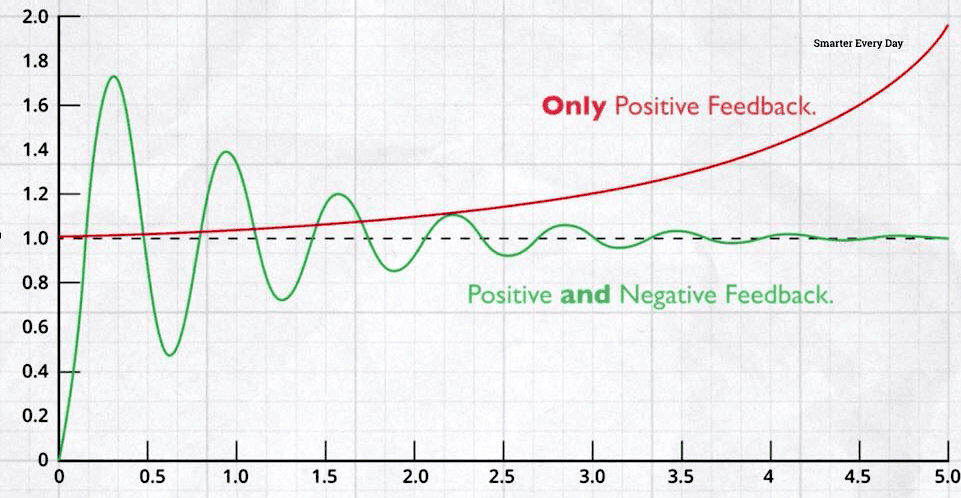
It isn’t difficult to understand how this impacts the speaker. They’re sharing the thing that worked for them. The thing that helped launch them into speaking in the first place. And almost all of the feedback they hear about it is how well it’s worked for people. That subset may be a small percentage of the overall audiences they’re speaking to, but that’s still likely to be a sizeable number.
Motivated Reasoning
This is compounded with the bias known as “Motivated Reasoning” which is best illustrated by the famous quote attributed to Upton Sinclair:
"It is difficult to get a man to understand something, when his salary depends upon his not understanding it."
There is little incentive for a speaker to dwell on or reconsider the small number of people who may reach out to them to say their advice didn’t work. It is easily shrugged off as an incredibly small number, or to hand wave and assume the ones providing the feedback must have done it wrong, or have other things going wrong as well, so it wasn’t their advice. (The “Horn Effect” in practice.)
The market is naturally going to reward a speaker who is confident in their cause, and believes in their advice, and performance. That self confidence is desirable. No one wants to hire a speaker to inspire others if they don’t even believe in themselves. The speaker, or their agent, is more likely to negotiate more strongly, for a fee commensurate with their perceived value. Enabling them to earn more, and thereby be more handsomely rewarded for perpetuating this cycle.
CAVEAT EMPTOR
The confluence of these factors makes it all too easy to get caught up in the hype cycle around a speaker. Especially one who is good at their craft - a good speaker is engaging, charismatic, and likely to have a halo effect all their own.
This frequently leads to speakers overstating their impact, naturally cherry picking the best stories from an already incredibly skewed sampling, and presenting them as average, or likely outcomes. This “promise” sets a high bar, and sets high expectations for those who follow their advice, or sign up for their classes, coaching, or consulting. The difficulty of high expectations? They’re hard to meet. So now a large subset of this audience is set up to be underwhelmed with the outcome.
Most will keep this failure quiet, and, due to this silence, believe themselves to be in a small minority. The more likely reality is that they are part of a much larger group that is underrepresented by a confluence of natural factors in both our minds and our society that celebrate success and sequester failure.
As Mary Schmich famously said:
Be careful whose advice you buy.
And beware of anyone who says a problem is simple.
Success is never just one thing. No one else is you, in your situation, with the other variables you have to deal with.
The best bit of advice I’ve ever received?
“You’ll have to figure out what works for you.”
Mahalo,
Yoko
PS - Please note: I think there are a LOT of great speakers out there. I’ve gotten some life changing ideas thanks to the luck of being in the right audience at the right time. That said, the ones with the biggest impact on me have been the ones most focused on helping the audience, not selling the next thing.
PPS - If you're as sad as I am that the stream providers only use a re-recorded version of the Baz Luhrmann Everybody's Free song, enjoy this nostalgic link back to the OG 1999 recording.